
Domestic Violence Divorce in Malaysia: Mother Wins Sole Custody and Half the Sale Proceeds of the Family Home
Outcome
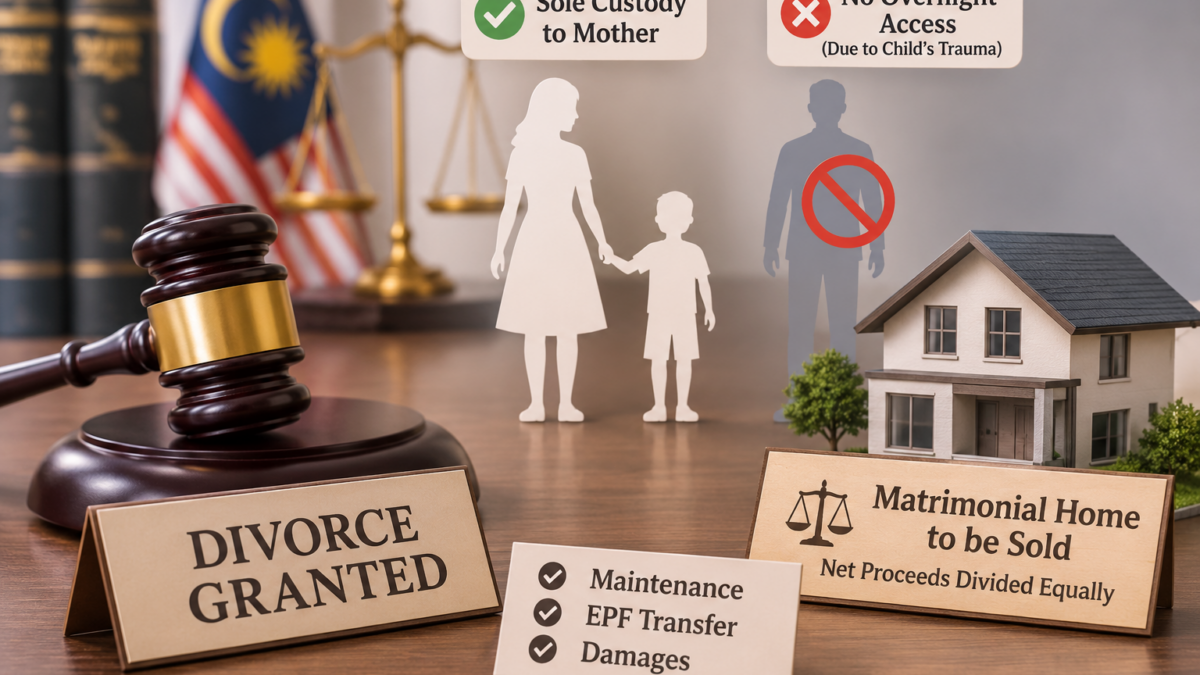
The court granted the divorce, awarded sole custody of the child to the mother and refused the father overnight access due to the child's trauma. It also ordered the matrimonial home to be sold, with the net proceeds divided equally, alongside maintenance, EPF transfer and damages.
Case Background & Strategy
Case commentary on Malaysian family law by Lawyer Khoo Ai Theng (Maxine Khoo), Partner at Messrs Ng, Zainurul, Seke & Khoo (NZSK).
Independent case commentary: this article discusses a reported Malaysian judgment in which other counsel appeared. It is not presented as a case handled by NZSK.
A domestic violence divorce in Malaysia can affect much more than the decree itself. It can decide who the children live with, whether the other parent may have them overnight, and how the family home is shared. In this case the court granted the divorce, gave the mother sole custody of her son, refused the father overnight access because of the child’s trauma, and ordered the matrimonial home to be sold with the net proceeds divided equally, even though the house was registered in the husband’s name.
Key takeaways
- Evidence of violence in the home can shape custody and access, including whether a parent is allowed overnight stays with the child.
- The court listened to the child’s fears when deciding what contact was safe.
- A home acquired during the marriage can be divided even if only one spouse’s name is on the title.
- A single divorce order can deal with custody, maintenance, the family home, EPF savings and damages together.
Case at a glance
| Item | Detail |
| Type of case | Divorce with custody, access, maintenance and division of matrimonial assets |
| Allegations | Violence, cruelty and adultery, which the husband disputed |
| Custody | Sole custody to the mother |
| Access | No overnight access for the father, because of the child’s trauma |
| Matrimonial home | To be sold, with the net proceeds divided equally |
| Other orders | Maintenance, an EPF transfer and an assessment of damages |
What happened in this case?
After years of marriage, the wife said that she and her son had been driven out of the family home amid violence and an affair. The husband disputed the allegations. He also suggested that he did not have the means to pay the financial support sought.
What did the court have to decide?
The court had three connected questions to answer. First, whether the evidence of cruelty and adultery was made out. Second, what custody and access arrangement would protect a child who was afraid, and the court listened to the child’s fears in deciding this. Third, whether the marital home was a matrimonial asset that could be divided, given that it was registered in the husband’s name alone.
What did the court decide?
The court granted the divorce. The mother received sole custody of the son, and the father was not permitted overnight access because of the trauma the child had experienced.
The matrimonial home was ordered to be sold, with the net proceeds divided equally between the spouses, because it was an asset acquired during the marriage. The order also provided for maintenance, a transfer of EPF savings and an assessment of damages.
What should you know about a domestic violence divorce in Malaysia?
Under the Law Reform (Marriage and Divorce) Act 1976 (LRA), the only ground for divorce is that the marriage has broken down irretrievably (section 53). The breakdown is proved by one of the facts in section 54, which include adultery that the petitioner finds intolerable, and behaviour by the respondent such that the petitioner cannot reasonably be expected to live with him or her. Violence and cruelty are usually relied on under the behaviour limb.
Protection does not have to wait for the divorce. The Domestic Violence Act 1994 allows a victim to apply for an interim protection order and a protection order, and section 103 of the LRA allows the court to grant an injunction against molestation during and after matrimonial proceedings.
On the children, section 88 makes the welfare of the child the paramount consideration, and section 89 allows the court to attach conditions to custody and access. That is how a court can refuse overnight stays or limit contact to what is safe.
On property, section 76 allows the court to divide assets acquired during the marriage. It looks at each party’s contributions, including contributions to the welfare of the family by looking after the home or caring for the family, any debts incurred for the family, the needs of the children and the length of the marriage. The name on the title is not decisive.
Lawyer Khoo Ai Theng’s view
Domestic violence evidence can change both custody and access. Courts take seriously what a frightened child says and how the child has been affected, and they will tailor contact accordingly. Just as importantly, a spouse who leaves the home to stay safe does not give up a claim to it. In this case the wife said she and her son had been driven out of the house, and she still received an equal share of the net sale proceeds.
The other lesson is that a spouse’s name on the title does not settle who gets the matrimonial home. What matters is when and how the asset was acquired and what each spouse contributed to the family.
What should you do if you are in a similar situation?
- If you or your children are in immediate danger, call 999 first. Safety comes before paperwork.
- Make a police report and keep copies of medical reports, photographs, messages and anything else that records what happened.
- Note how the children have been affected, including anything said to teachers, counsellors or doctors.
- Keep documents about the family home, such as the purchase papers, loan statements and records of payments, even if the property is not in your name.
- Get legal advice on protection orders, custody and the home as early as you safely can.
Frequently asked questions
Can I get a divorce in Malaysia because of domestic violence?
Yes. Under the Law Reform (Marriage and Divorce) Act 1976, you must show that the marriage has broken down irretrievably. Violence and cruelty are commonly relied on to prove that your spouse has behaved in a way that you cannot reasonably be expected to live with. Police reports, medical records and other evidence will help the court decide.
Can the court stop my ex-spouse from having overnight access?
Yes. The child’s welfare is the paramount consideration, and the court can attach conditions to access. In this case the father was not allowed overnight access because of the child’s trauma. Depending on the evidence, a court may also order daytime-only or supervised contact.
Can I claim a share of the house if it is only in my husband’s name?
Possibly, yes. Under section 76 of the LRA, the court can divide assets acquired during the marriage regardless of whose name is on the title. In this case the home was registered in the husband’s name, yet the court ordered it sold and the net proceeds divided equally.
What protection is available while the divorce is going on?
You can apply for an interim protection order or a protection order under the Domestic Violence Act 1994. During matrimonial proceedings, the court can also grant an injunction against molestation under section 103 of the LRA. If you are in immediate danger, call 999.
Need advice on a divorce involving domestic violence?
Lawyer Khoo Ai Theng and the family law team at Messrs Ng, Zainurul, Seke & Khoo (NZSK) act in child custody, access, maintenance, divorce and matrimonial asset matters. Because every outcome turns on the documents and the evidence, we give advice after reviewing them with you in a consultation. Consultations are by appointment, online or at our offices in Mont Kiara, Kuala Lumpur and Puchong, Selangor. New clients can call or WhatsApp 012-401 4799. You can also read more about our child custody practice.
Related reading
- Divorce for Unreasonable Behaviour in Malaysia: Custody Case
- Supervised Access in Malaysia: Mother Wins Sole Custody
About the author
Maxine Khoo Ai Theng is a Partner at Messrs Ng, Zainurul, Seke & Khoo (NZSK). She was admitted as an Advocate and Solicitor of the High Court of Malaya in 2014 and is the author of Child Custody in Malaysia: A Practitioner’s Comprehensive Guide (Thomson Reuters, 2026).
Khoo Ai Theng
NZSK Legal — Messrs. Ng, Zainurul, Seke & KhooSpeak to Khoo Ai Theng directly about your matter:
📍 Puchong (Selangor) | Mont Kiara (Kuala Lumpur)
🕐 Monday – Friday, 9:00 AM – 6:00 PM

