
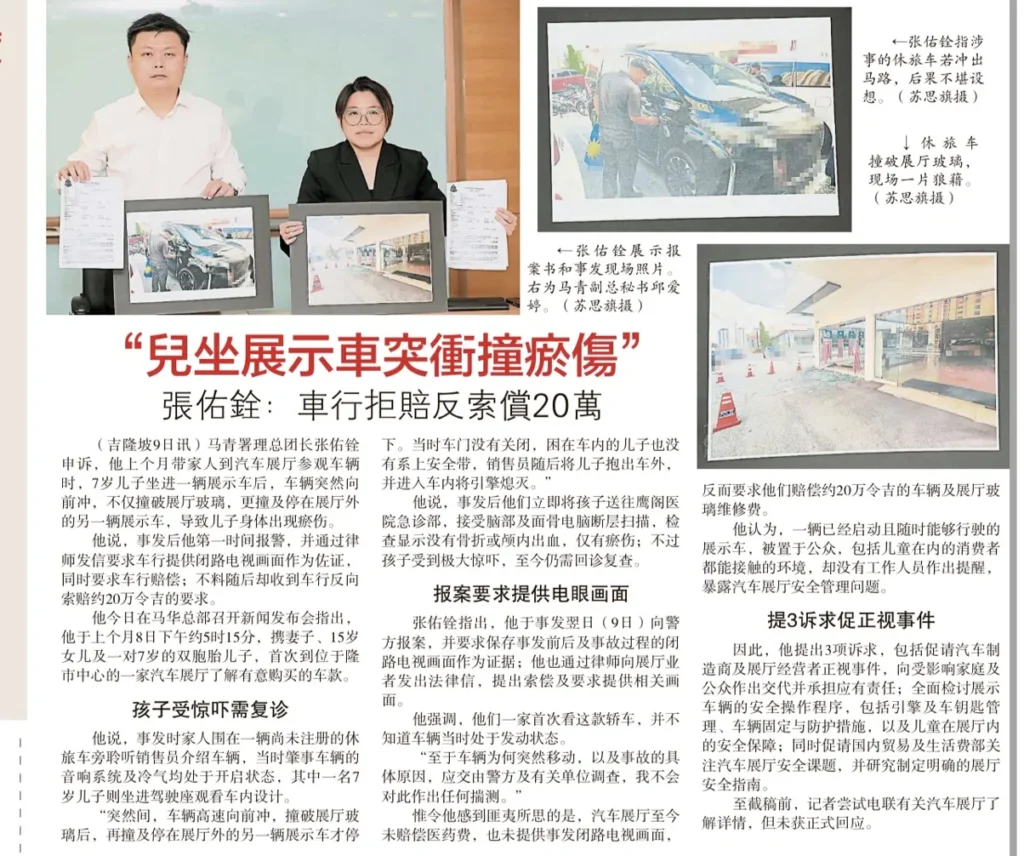
Lawyer Khoo Ai Theng has called for clear and enforceable safety standards governing display vehicles in car showrooms, after a seven-year-old boy was injured when a display car suddenly moved forward, crashed through the showroom glazing and struck a second vehicle parked outside.
She spoke at a press conference at MCA headquarters alongside MCA Youth National Deputy Chairman Mike Chong Yew Chuan, who brought the case forward. The family had visited a city-centre showroom to view a car they were considering buying. While they stood beside an unregistered display vehicle listening to a salesperson, one of the children climbed into the driver’s seat to look at the interior. The vehicle was reported to have had its engine, air-conditioning and audio system switched on at the time. It moved forward without warning. The child was taken to hospital, where scans showed bruising but no fracture or intracranial bleeding. He remains under follow-up review.
Khoo said the incident raises a straightforward question of premises safety rather than a difficult question of law. A showroom operator has control over its own display floor, and a customer who enters to view goods is a lawful visitor to whom a duty of reasonable care is owed. That duty is measured against the visitors the business actually expects to receive, and a business that invites families to view family vehicles must expect children to be on the floor.
She said that a display vehicle left with its engine running and within reach of the public is a hazard known to the operator and invisible to the visitor, and that is precisely the kind of danger the law requires an occupier to guard against. Simple precautions were available, she noted, including keeping ignitions off, holding keys under central control, engaging the parking brake and placing physical barriers around vehicles displayed next to glazing or walkways.
Khoo also addressed the showroom’s response. The family is reported to have received no payment of medical costs, no closed-circuit television footage despite a written request, and instead a counterclaim of around RM200,000 for repairs to the vehicle and the broken glass panel. A counterclaim of that kind is not a defence, she said. It is a separate claim, and the business advancing it must still prove that the customer owed it a duty, that the duty was breached, and that the breach rather than the condition in which the business left its own vehicle caused the damage.
On the footage, she stressed that closed-circuit television is often the most valuable evidence in an incident of this kind and also the most perishable, with many systems overwriting within weeks. Where footage is demanded in writing and not produced, a court may draw an adverse inference against the party withholding it. She urged anyone involved in an incident on commercial premises to lodge a police report immediately, put a written preservation request to the operator the same day, obtain a full medical report rather than a discharge slip, photograph the scene before it is cleared, and decline to sign any waiver or settlement while the extent of injury is still being assessed.
Three calls were made at the press conference. Manufacturers and showroom operators should account to the affected family and the public and accept responsibility. The industry should carry out a full review of display-vehicle safety procedures, covering engine and key control, the securing of vehicles, and the protection of children on the showroom floor. The Ministry of Domestic Trade and Cost of Living should examine showroom safety as a consumer issue and issue clear guidelines.
Khoo said that a showroom floor open to the public is not a private workspace, and that the cost of preventing an incident of this kind is a fraction of the cost of answering for one.
The showroom had not issued an official response as at the time of reporting. The premises and the injured child are not identified, and the matters described remain allegations that have not been determined by any court.
